



Blog
Is Repairing Your Phone Actually Better for the Environment?

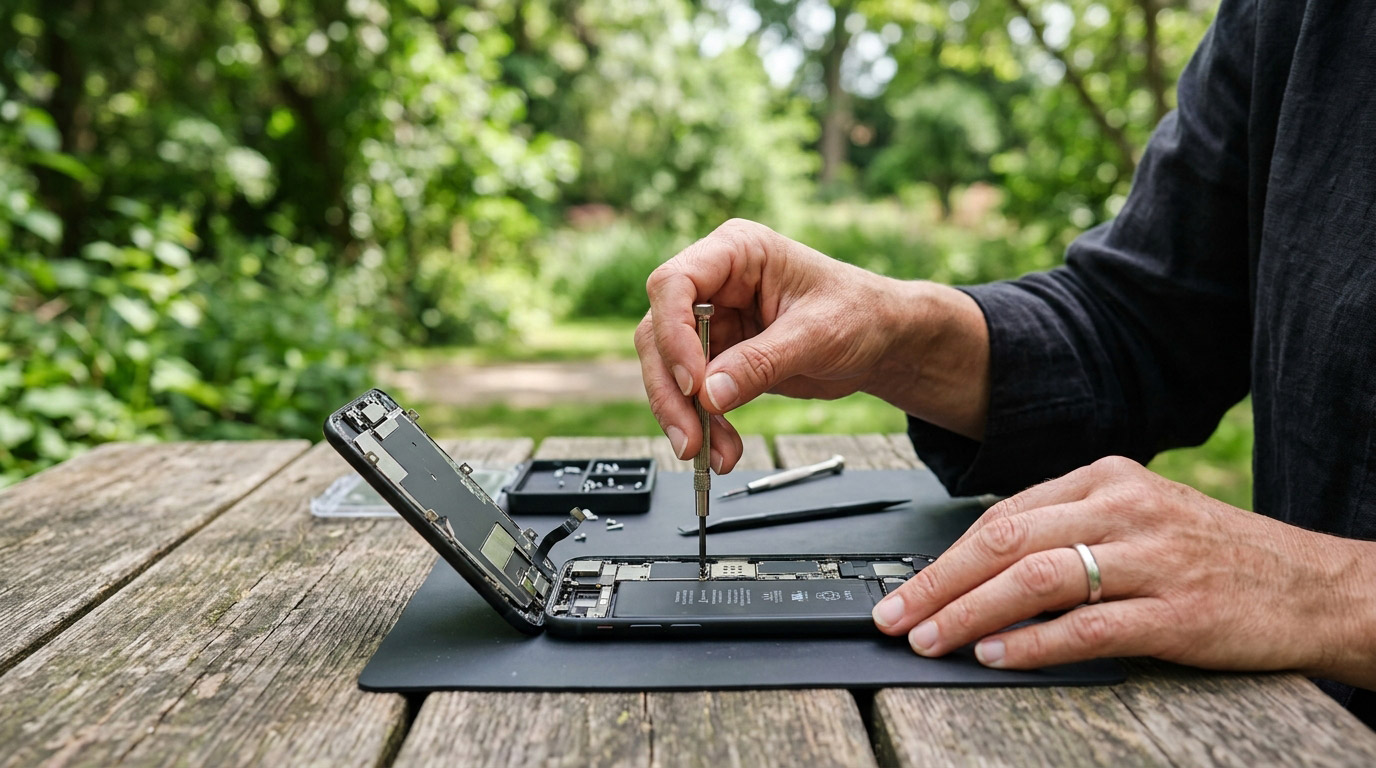
Most people assume that a phone’s environmental footprint accumulates during use from the electricity it consumes over years of charging. That assumption is wrong.
The overwhelming majority of a smartphone’s carbon footprint is generated during manufacturing before you ever take it out of the box.
Apple has published lifecycle assessments for its iPhone models showing that manufacturing accounts for approximately 80 to 85% of total carbon emissions across a phone’s entire life. Samsung‘s lifecycle data tells a similar story. The mining of rare earth materials, the energy-intensive fabrication of chips and displays, and the global supply chains that move components from dozens of countries to a factory in Asia all of this happens before the phone reaches your hands.
What this means in practice: the environmental decision isn’t primarily about how you charge your phone. It’s about whether you buy a new one.
Every time a phone is repaired and kept in service rather than replaced, the energy and emissions that would have gone into manufacturing a new device are avoided. That’s not a small number.
The Numbers Behind Repair
In 2022, the United States alone generated over 7 million tons of e-waste a number that continues to grow. Globally, e-waste reached 62 million tonnes in 2022 and is projected to grow to 82 million tonnes by 2030.
In 2022, only 22.3% of the 62 million tonnes of e-waste generated globally was formally collected and recycled. The rest the vast majority ends up in landfills, informal recycling operations, or illegal export.
Discarded devices do not simply sit inert underground. Over time they leach toxic compounds into surrounding soil and groundwater, including lead, mercury, cadmium, and brominated flame retardants persistent, bioaccumulative substances with well-documented links to neurological damage, kidney disease, and long-term ecosystem disruption.
Microsoft conducted research finding that repairing a product creates far less waste and results in 89% reduced greenhouse gas emissions compared to replacing it. That figure 89% puts the environmental case for repair in clear terms.
Americans could save $49.6 billion annually by repairing rather than replacing some common household products. The environmental savings operate at the same scale.
What Happens When You Throw a Phone Away
When a phone ends up in landfill as most do its toxic materials begin a slow process of leaching into the environment.
Smartphones contain lead in solder joints and circuit boards. They contain mercury in certain display components. They contain cadmium in some battery types and coatings. They contain brominated flame retardants throughout the housing and circuit boards. None of these substances belong in soil or groundwater, and none of them break down safely.
The raw materials in 62 million tonnes of e-waste were valued at $91 billion in 2022, with only $19 billion recovered through environmentally sound recycling. The rest including gold, silver, copper, and rare earth elements mined at significant environmental cost is simply lost.
The irony of e-waste is that the same materials that make phones expensive to manufacture are abandoned in landfills because recycling infrastructure hasn’t kept pace with consumption.
Repair Extends the Life of What Already Exists
A repaired phone doesn’t require new mining, new chip fabrication, or new global shipping. Every component already exists, already paid its environmental price. Keeping it in service is, in carbon terms, almost free compared to manufacturing a replacement.
This is why repairability transparency increases incentives for manufacturers to make more repairable products, resulting in substantial and much-needed environmental benefits and e-waste reduction.
The math scales impressively. If the average American replaced their phone at year 5 instead of year 2.5, the number of phones manufactured each year would roughly halve for that segment of the market. The reduction in raw material extraction, manufacturing energy, and shipping emissions would be significant at national scale.
At the individual level: choosing to repair your phone this year instead of replacing it saves roughly 40 to 80 kilograms of CO₂ equivalent emissions — comparable to driving 100 to 200 fewer miles in a typical car.
What About Recycling? Isn’t That Enough?
Recycling is better than landfill, but it’s not equivalent to repair and it’s often presented as a more complete solution than it actually is.
Recycling recovers some materials, but the process itself is energy-intensive. Valuable rare earth elements are often not recovered at all due to the difficulty of separating them from other materials. And recycling a phone doesn’t avoid the manufacturing impact of the new phone that replaces it — it only recovers a fraction of the old one’s material value.
The environmental hierarchy is clear and well-established: Reduce → Reuse → Repair → Recycle → Dispose. Repair sits near the top of that hierarchy. Recycling is several steps lower better than disposal, but not a substitute for keeping working devices in service.
The Repairability Problem: Designed to Break
Not all phones are created equal in terms of environmental impact and design choices made by manufacturers matter enormously.
Many phones and laptops on the market are designed to be so difficult to fix that they become essentially disposable once they start to malfunction.
Strong adhesive instead of screws makes disassembly destructive. Proprietary fasteners require tools only manufacturers stock. Fused display assemblies mean a cracked outer glass requires replacing the entire screen. Parts pairing software prevents used genuine parts from being installed without manufacturer authorization.
These design choices — made in the name of thinness, water resistance, and aesthetic appeal have a direct environmental cost. A phone that can’t be economically repaired gets replaced. A phone designed for repair gets fixed and kept.
The European Union now requires that electronics manufacturers display a repairability score at the point of sale. The vast majority of French consumers say they would give up their favorite brand for a more repairable one.
The U.S. is moving in this direction through right to repair legislation, including Texas’s HB 2963 that took effect September 1, 2026. But consumer awareness remains the most immediate driver of change.
Small Choices That Add Up
You don’t have to overhaul your lifestyle to make a meaningful environmental difference with your phone. The choices are practical and financial as much as they are environmental:
Get it repaired when it breaks. A cracked screen, dead battery, or broken charging port are all fixable. Choosing repair over replacement avoids manufacturing a new device and keeps a functional one in service.
Keep it longer. Every additional year a phone stays in use is a year a new phone doesn’t need to be manufactured. Three years instead of two is a 50% improvement in per-year manufacturing impact.
Protect it properly. A quality case and screen protector prevent damage that leads to premature replacement. A $30 case protects a $900 device — and the environmental cost of manufacturing it.
Don’t upgrade for marginal improvements. The camera in a two-year-old flagship is excellent. The performance is sufficient for virtually any everyday task. Marketing exists to convince you otherwise. The environment and your wallet benefit when you’re skeptical of that argument.
Stop to Fix: Repair Is Our Business, and It Matters
Every phone we repair at Stop to Fix is a phone that doesn’t go to landfill. Every battery we replace extends a device’s useful life by years. Every screen we fix keeps a functional phone out of the waste stream.
We’re a local business, not a multinational manufacturer. Our interests are aligned with yours: we want your phone to last as long as possible, because that’s when you trust us and come back. We’ve been doing this in San Antonio because we believe repair is the right answer economically and environmentally.
📍 Bandera Road: 11851 Bandera Rd., Suite 104, San Antonio, TX 78023
📍 Pleasanton: 1320 W Oaklawn Suite D, Pleasanton, TX 78064
📞 Bandera: (210) 325-9913 | Pleasanton: (210) 371-8328
🌐 stoptofix.com/get-instant-estimate